Moving the Signal Fire to the Beach
Lord of the FliesMoving the Signal Fire to the Beach is a practical response to a crisis of leadership and fear: after Jack Merridew’s departure, Ralph and Piggy relocate the fire from The mountain to the sand beside The platform, where it is easier to reach and less frightening to tend. Piggy turns the loss of the mountain fire into a workable alternative, and Ralph adopts it. The new fire restores a shared task, but its lower position compromises the visibility on which rescue depends.
Causes and Background
The move follows a deepening division among the boys. As belief in The beast unsettles assemblies, Ralph struggles to keep attention on the signal fire and the rules meant to organize their common life. At a meeting, Simon cautiously suggests climbing The mountain, but his proposal meets dread and derision rather than a plan. Piggy argues that the boys can do without a particular person and redirects the discussion to what they can control: the smoke and the fire needed to make it.
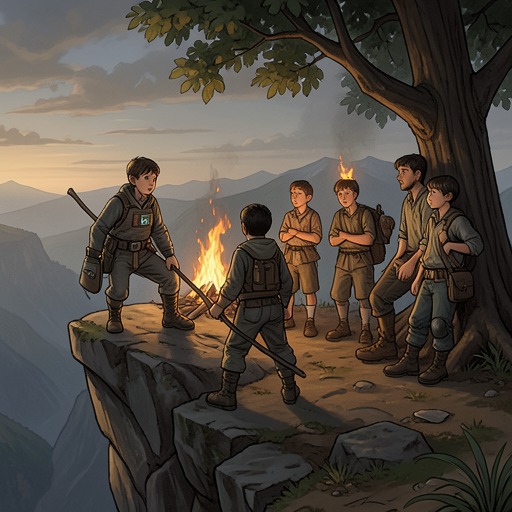
The immediate obstacle is more than distance. Ralph says there is no fire on The mountain, and the thing that makes it dangerous is still up there. The boys cannot simply resume their former routine at the summit. Jack Merridew’s break with Ralph has also taken hunters away from the group, leaving fewer older boys to do the work. The relocation therefore answers two connected problems: fear makes the mountain inaccessible, while the departure of boys makes the established system harder to sustain.
Choosing a New Site
Piggy proposes making a fire down by the bathing-pool, on the sand, rather than returning to the summit. His reasoning is practical: smoke can still be made there, and the boys need not go near the feared place. Ralph considers the limitation before agreeing. A fire lower down will not show as well or be seen from as far away, but keeping close to the group is safer than attempting to tend a fire at the mountain. The decision trades the best possible signal position for a location the remaining boys can actually use.
Once Ralph accepts the plan, the group has something immediate to do. The boys decide to build the fire between the bathing-pool and The platform. For Piggy, the proposal is also a chance to contribute to the group’s survival in a way that does not depend on hunting. He is proud of having suggested it and joins in gathering fuel. The practical work briefly gives the boys a common purpose at a moment when their political unity has already weakened.
Building and Kindling the Fire
The wood is gathered nearby, including from a fallen tree on The platform. Unlike the drier fuel used on The mountain, much of it is damp, rotten, or full of insects; some of it crumbles when lifted. Rather than venture deeply into The forest, the boys collect fallen wood close to familiar ground. Their energy is conspicuous, but it carries a strain: as they work, their cheerfulness grows increasingly hysterical, while the darkening prospect of being away from the group is left unexamined.
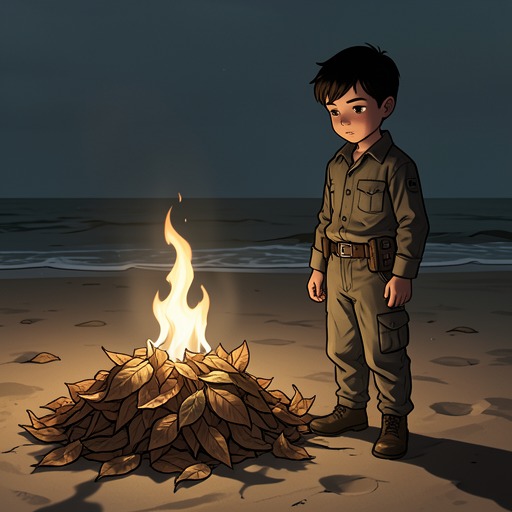
They pile leaves, twigs, branches, and logs on the bare sand. Piggy removes his one remaining lens, kneels, and focuses sunlight on the tinder. The new fire catches, producing a ceiling of smoke and a bush of yellow flame. The scene makes the relocation tangible: Piggy, whose glasses have helped make fire possible before, now directly kindles the fire on the sand. The younger boys, who have seen few fires since the first catastrophe, dance and sing around it. For a short while, the work feels celebratory as well as necessary.
Ralph soon judges the blaze too large to maintain and calls for a smaller fire. Piggy suggests experimenting with a smaller, hotter fire and using green branches to make more smoke. The excitement fades as the flames die down, however, and the new site does not solve the problem of who will tend it. Ralph proposes making another list of fire-keepers, then notices how few older boys remain. When he names those who might help, he finds that some have gone; Piggy has seen them slipping away in the same direction as Jack Merridew. The fire has moved, but the labor and loyalty it needs have not been secured.
Consequences and Significance
The relocation preserves the signal-fire duty as an ideal while exposing how fragile it has become in practice. Near The platform, the fire is accessible and can comfort the boys at night; away from the summit, its smoke is less visible to any passing ship. Its usefulness now depends not only on a good location but also on steady attendance from a shrinking group. Piggy’s practical intelligence solves the immediate problem of where and how to light it, without restoring the shared commitment that once made the summit fire a collective responsibility.
The contrast with Jack Merridew’s rival group sharpens that uncertainty. Later, Jack plans to raid Ralph’s camp to take fire rather than make one himself, showing that fire remains valuable even as the boys’ common order breaks apart. The beach-side fire is thus both a survival measure and a marker of division: Ralph’s group brings the task closer to safety, while the act of maintaining it grows harder as the group loses members. The move does not end their dependence on fire for rescue; it reveals the widening gap between that hope and their capacity to sustain it.